 Yogyakarta's Heritage · Authentic Hand-Crafted Batik
Yogya Batik: Authentic Hand-Stamped & Hand-Drawn Textiles
Source exquisite hand-stamped and hand-drawn batik from Yogyakarta, Indonesia. We offer a curated collection of traditional and contemporary designs, crafted with natural dyes and premium cotton, for fashion designers, retailers, and textile importers worldwide.
What are you looking for?
Tell us your needs and we'll guide you to the perfect batik.
As an international buyer seeking a reliable supply of Indonesian batik, you require clarity on sourcing, quality, and logistics. We understand the specific demands of textile import, from material specifications to regulatory compliance and timely delivery. At Yogya Batik, we act as your direct point of contact in Yogyakarta, managing the entire export process to ensure your orders meet precise commercial standards. We facilitate access to authentic batik production, bridging the gap between local artisan workshops and global markets efficiently.
Sourcing Authentic Batik from Yogyakarta
Yogyakarta stands as one of Indonesia’s primary traditional batik production centres, a fact that underscores the authenticity of our offerings. This region, often referred to as Jogja, shares its esteemed position with other historical hubs such as Solo, Pekalongan, and Lasem. Our operations are deeply rooted here, giving us direct access to established workshops and skilled artisans. We work closely with these local producers, many of whom operate as micro, small, or medium enterprises (MSMEs) and are often registered with local cooperatives. This structure allows us to support local industry while ensuring quality control for our international clients. Traditional Javanese batik motifs associated with Yogyakarta, including *parang*, *kawung*, *saturi*, *ceplok*, and *mega mendung*, form a core part of our available designs, each carrying codified meanings in local culture. We ensure that the cultural integrity of these designs is maintained throughout the production process. Our sourcing strategy prioritises workshops that adhere to traditional methods, whether for everyday cotton fabrics or higher-end silk batik. This direct engagement ensures verifiable origin and quality for every meter of fabric or finished garment we export.
Our Production Capabilities: Tulis, Cap, and Customisation
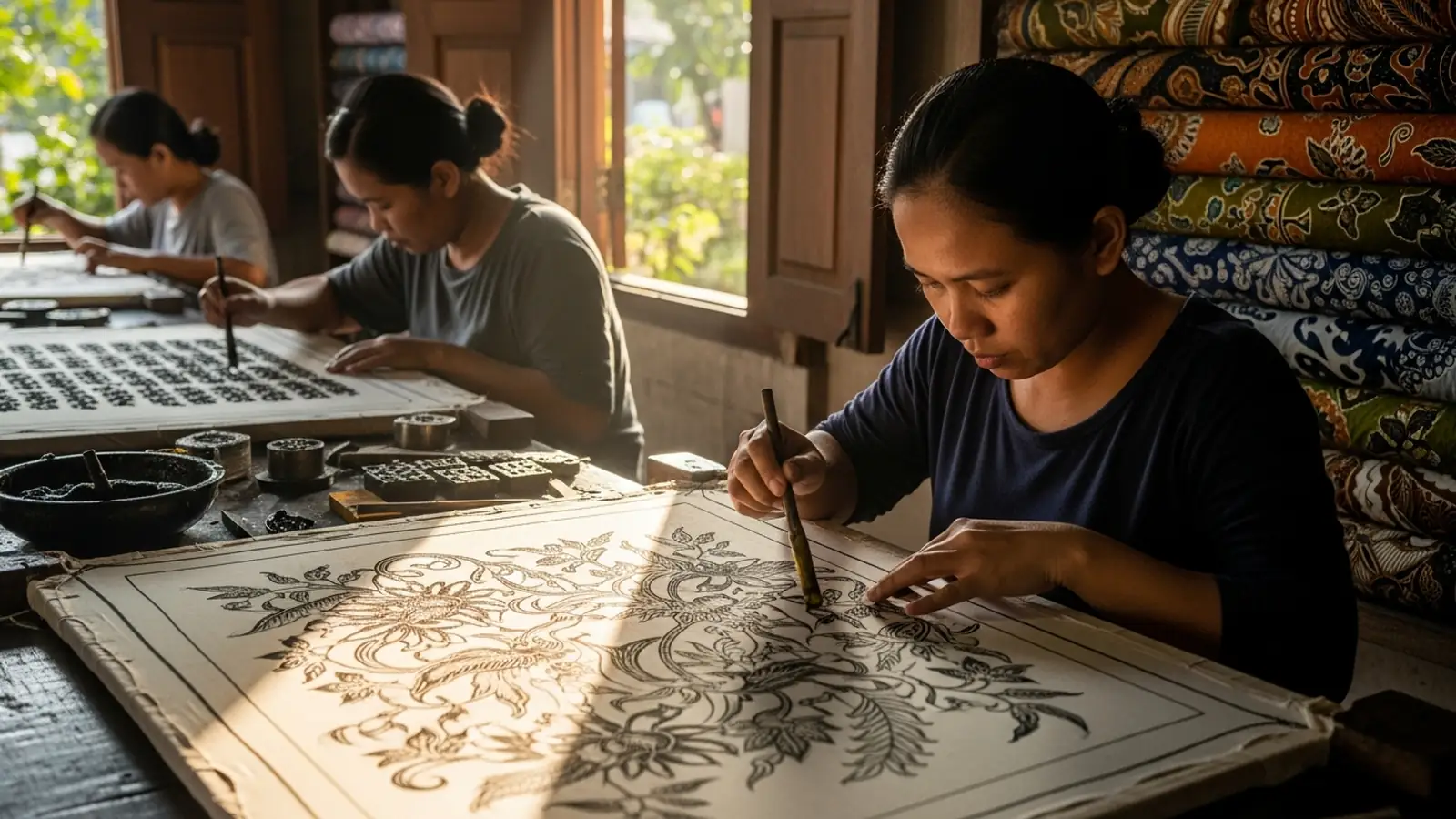
Yogya Batik offers a comprehensive range of production capabilities, focusing on both traditional techniques and modern commercial requirements. We supply hand-drawn batik (*batik tulis*) and stamped batik (*batik cap*), understanding the distinct value proposition of each. Hand-drawn batik is significantly more labour-intensive, often requiring several days to weeks per piece, depending on the complexity of the motif and the skill of the artisan. This method yields unique, high-value textiles. Stamped batik, while quicker to produce, still requires considerable skill and offers consistent patterns ideal for larger commercial runs. For base fabrics, many batik makers in Yogyakarta use 100% cotton for everyday wear and general export fabrics, while silk batik is reserved for higher-end products due to its luxurious feel and drape. We also facilitate the use of different dye types: some workshops utilise natural dyes, such as indigo and soga brown, for eco-friendly lines, while most commercial batik employs synthetic fibre-reactive dyes for superior colourfastness and wider palette options. Furthermore, we provide custom design services. Many Yogyakarta batik exporters are equipped to supply custom designs based on buyer artwork, usually involving design or setup fees or requiring higher minimum order quantities (MOQs) per specific motif. This allows clients to develop exclusive lines tailored to their market needs.
Ensuring Compliance and Transparent Export Processes
Navigating international trade regulations is a critical component of our service at Yogya Batik. We ensure full compliance with all necessary Indonesian export requirements. To export textiles from Indonesia, companies like ours must hold a valid Indonesian business license (e.g., PT, CV, or sole proprietorship) and obtain a Tax ID (NPWP). We are registered with the Indonesian Ministry of Trade as exporters, a mandatory step for consistently shipping commercial quantities abroad. Our operational transparency extends to classification: batik fabrics shipped internationally are commonly classed under HS codes in Chapter 52–55 for cotton/synthetic woven fabrics or Chapter 62 for garments, depending on the product type. This precise classification is vital for smooth customs clearance. For exports to the European Union, batik textiles are subject to normal EU import duties and VAT, with specific duty rates dependent on fabric composition and the assigned HS code. Similarly, for exports to the United States, batik garments and fabrics are subject to US customs duties under corresponding HTSUS codes; note there is no batik-specific free-trade agreement currently in place. We also address product safety: commercial batik textiles produced for export must comply with destination-market regulations on azo dyes and formaldehyde, particularly EU REACH and related standards for harmful substances in textiles. Buyers importing into the EU often request Oeko-Tex Standard 100 or equivalent compliance declarations, and we work with workshops to provide these where applicable, even if they do not hold full certification themselves. We provide all necessary documentation, including commercial invoices, packing lists, and certificates of origin, coordinating fumigation certificates if required by the destination country. This rigorous approach minimises delays and ensures legal entry into your market.
Pricing Structure and Minimum Order Quantities
Understanding the financial aspects of your order is straightforward with Yogya Batik. Our pricing is structured to reflect the craftsmanship, material, and volume. For indicative wholesale prices, printed or stamped batik cotton fabric (not hand-drawn) exported from Indonesia often starts around USD 3–6 per meter for standard-quality yardage. This price varies depending on the order size, design complexity, and specific finishing requirements. Hand-drawn batik *tulis* garments from Yogyakarta, being fully handmade, commonly retail internationally from about USD 80–250 per piece or more, with the final price influenced by the artisan, specific brand, and whether the base fabric is silk or cotton. We operate with clear minimum order quantities (MOQs) to ensure efficiency in production and logistics. Small exporters in Yogyakarta typically require MOQs in the range of 50–100 meters per design for fabric orders or 20–50 pieces per model for garments. These quantities allow our partner workshops to allocate resources effectively and maintain competitive pricing. Payment terms are also transparent: many Indonesian batik exporters, including our partners, ask for a 50% deposit on order confirmation, with the remaining 50% balance due before shipment. This arrangement is particularly common for new buyers without an established prior relationship. International buyers usually pay in USD via bank transfer (TT), PayPal, Wise, or Letter of Credit (LC) for larger orders. PayPal and Wise are often more common for micro-exporters and smaller initial orders, while bank transfers and LCs are preferred for substantial commercial volumes. We are committed to providing detailed quotations based on your specific order parameters. For a precise quote, please visit our contact page.
International Logistics and Shipping Considerations
Efficient and secure delivery is paramount for international textile trade. Yogya Batik manages the logistics from our workshops in Yogyakarta directly to your designated port or address. For smaller, higher-value orders, most Yogyakarta batik exporters ship via air freight, utilising reputable carriers such as DHL, FedEx, and UPS. This method ensures faster transit times, typically suited for urgent or lower-volume shipments. For large volume shipments, we arrange sea freight, offering both Less than Container Load (LCL) and Full Container Load (FCL) options. Sea freight is the most cost-effective solution for bulk orders, though transit times are longer. When shipping by sea, batik fabrics are generally packed in plastic-wrapped bundles, then secured in cartons or bales, with desiccant packs included to mitigate moisture damage during the extended transit. It is important to consider the local climate and holiday schedules. Indonesia experiences a rainy/monsoon season typically spanning roughly November–March, which can affect local logistics, drying times for batik production, and domestic transport to ports. Additionally, many Yogyakarta batik workshops schedule higher production volumes before Ramadan and Eid (Lebaran) due to increased domestic demand and local holiday sales. Export-oriented batik producers often avoid shipping near major Indonesian public holidays, such as Idul Fitri, Christmas, and New Year, because trucking and port operations can experience significant delays during these periods. We proactively communicate these potential factors to manage expectations and ensure timely delivery planning.
Quality Assurance and Material Specifications
At Yogya Batik, our commitment to quality assurance underpins every export order. We work with producers who primarily use 100% cotton as the base fabric for everyday wear and the majority of our export fabrics. This choice is driven by cotton’s versatility, durability, and excellent dye absorption properties. For clients seeking premium options, silk batik is also available, reserved for higher-end products due to its luxurious texture and drape. The choice of dyes is also a key quality consideration. While some Yogyakarta batik workshops utilise natural dyes, such as indigo and soga brown, for eco-friendly lines and specific aesthetic preferences, most commercial batik relies on synthetic fibre-reactive dyes. These synthetic dyes offer superior colourfastness, ensuring the batik patterns remain vibrant and do not bleed or fade significantly after washing, which is crucial for consumer satisfaction. Furthermore, all commercial batik textiles produced for export through Yogya Batik comply with stringent destination-market regulations concerning harmful substances. This includes adherence to standards on azo dyes and formaldehyde, particularly those mandated by EU REACH and other relevant textile safety regulations. Buyers importing into the EU often request Oeko-Tex Standard 100 or equivalent compliance declarations. While not all smaller workshops hold full certification, we facilitate the provision of declarations where possible, verifying material safety to meet your import requirements. Our quality control checks are implemented at various stages of production and packaging to ensure that the finished product meets the agreed specifications before shipment.
Partnering with Yogya Batik: Your Supply Chain Advantage
Partnering with Yogya Batik means leveraging a dedicated export house that understands both the intricacies of Indonesian batik production and the demands of international trade. Indonesia’s batik industry is formally recognised by the Indonesian government as part of the *Industri Kreatif* (creative industries) and *Industri Kecil dan Menengah* (IKM – small and medium industries), a recognition that highlights its economic and cultural significance. This official support provides a stable environment for our operations. Furthermore, the UNESCO inscription of Indonesian batik on the *Representative List of the Intangible Cultural Heritage of Humanity* in 2009 is widely referenced in our marketing and underscores the cultural value we bring to your product lines. When you work with us, you gain a partner committed to transparent processes and reliable lead times. Lead times for batik export orders from our Yogyakarta workshops commonly range from 4–8 weeks from deposit to shipment for medium-size orders, depending on complexity and the current production season. We streamline communication and oversight, ensuring your orders progress smoothly. International buyers typically pay in USD, and we facilitate secure transactions via bank transfer (TT), PayPal, Wise, or Letter of Credit (LC) for larger orders, offering flexibility to suit your business scale. By choosing Yogya Batik for wholesale fabric or custom manufacturing, you